
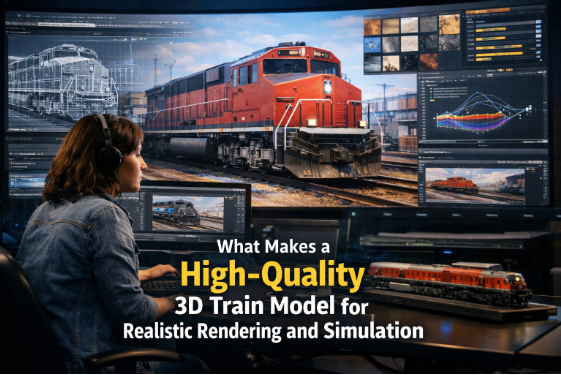

As a result of the growing use of digital technology in rail projects, the demand for visual and simulation content has dramatically escalated. A train model today is not just a reference material; rather, it is also a tool that helps achieve realistic rendering, technical verification, training, and simulation.
In this case, it becomes essential that the difference between a simple and a good 3D train model has a direct impact on decision-making, efficiency, and project delivery.
To offer actual value, the train model needs to ensure the right mix of realism, accuracy, and performance. Here are the essential factors that make the best train model for a realistic rendering and simulation setup.
Accurate Geometry and Proportions
Any good train model starts with geometric accuracy. This involves proportions, size, and relations corresponding fully to reality.
Error-free geometry provides the following:
- Proper scale for rendering and camera angles
- Correct clearance and spacing in simulations
- Appropriate alignment of platforms, tunnels, and infrastructures
Even minor errors can lead to misjudgment in visual displays or incorrect results in simulation. Quality models are generated from real-world specifications and references, not assumptions.
High-quality Exterior and Interior Modeling
For a realistic presentation, details of the surfaces are important. External details such as doors, windows, bogies, pantographs, headlights, and couplers need to be modeled.
Equally important is the interior. Cabins for passengers and drivers, seating configurations, handrails, control panels, and removal areas all impact realism.
Accuracy in the interior is important for:
- Driver training simulators
- Visualization of Passenger Experience
- Fire safety and evacuation considerations
A good 3D train model must ensure consistency in detail, both internally and externally, without being overly complicated.
Realism also relies greatly on light interactions with surfaces. Realistic models use physically based rendering materials. These materials attempt to accurately reflect the properties of matter in the real world.
Clean Topology and Structured Modeling
The model could be aesthetically pleasing and yet fail in simulation, especially when it is not properly structured. It is, therefore, essential to ensure that the topology is clean. This will ensure that the geometry, although complex, will be efficient, modifiable, and compatible with various platforms.
High-quality modeling involves the following best practices:
- Logical component separation
- Naming conventions
- Unnecessary use of geometry
- Edge flow for clean and smooth operation
This model can be applied again and again in all the rendering engines, simulation software, and even in the real-time environment.
Real-Time Simulation Optimization
Simulation setups need models that execute flawlessly in real-time. Dense meshes and improperly optimized textures could lead to slowdowns, stutters, and even crashes.
An excellent train model is optimized by:
- Balancing detail and performance
- Applying the level of detail (LOD)
- Improving texture resolution
- Guaranteeing efficient polygon distribution
This optimization is critical in driver simulator design, operation testing, and interactive training tools where usability is directly related to performance.
Integrating With Simulation Logic and Systems
In simulation scenarios, it’s not sufficient to rely solely on visual accuracy. The simulation has to be properly integrated with simulation logic, physics, and behaviors.
This includes:
- Correct pivot points for doors and moving parts
- Correct alignment for visibility and sightlines
- Compatibility with motion, braking, and signaling logic
When the visual and functional aspects come together, it increases the reliability of the simulation as well as the effectiveness of training.
Scalability and Future Adaptability
The railway infrastructure has long life cycles, and the model needs to be long-lived and duration-appropriate itself. A good 3D representation of the train needs to change and mature along with the project.
Such collaboration helps teams:
- Update liveries or branding
- Refurbish interiors
- Adapt models to new variants
- Integrate future system upgrades
Scalability helps to ensure that large investments of money and other resources aren’t required for redevelopment.
Consistency Across Rendering And Simulation Use Cases
One of the greatest markers of quality is flexibility. Indeed, a quality train model can be effortlessly adapted for:
- Client applications
- Database work
- Web development
- High-end photorealistic rendering
- Live simulation
- Training environments
- Engineering coordination displays
This ensures consistency between what is visible to stakeholders in renderings and what is experienced by operators in simulators to prevent a disconnect between what was expected and what was realized.
Importance of Professional Visualization Expertise
To achieve this balance, it requires specific knowledge and skills. The rail industry is known to work with a professional 3D visualization company that is competent in both visual storytelling and technical simulation.
Experienced teams will:
- Rail industry standards compliance
- Technical data interpretation
- Models that work well on multiple platforms
Such expert knowledge is often the criterion that differentiates production models from models that are aesthetically stunning but lacking in terms of technical capabilities.
Conclusion
A good 3D train simulation model will also be determined by the degree of its functionality and efficiency that is achieved within a rendering and simulation environment. Geometry, materials, organization, and compatibility all serve a critical purpose in the creation of a successful and functional 3D train simulation model.
With the help of an expert 3D visualization firm, these models can not only help in designing and training but can also act as an asset for a prolonged period. For today’s intricate transport projects, the need for effective modeling is not an optional criterion but a mandatory one in order to experience realistic and future-ready results.